Tree Removal in Athens, GA
We take down trees across Athens-Clarke County: dead pines, hardwoods that have been damaged in a storm, trees leaning toward the house, and trees that were planted too close to something forty years ago and have now won the argument.
If a tree is already on a structure or a power line, that is a job for our emergency tree service in Athens. Call (571) 412-0006 instead of reading further.
How to tell a tree needs to come down
Some of this you can see from your own back door. Some of it takes a closer look.
Signs worth acting on quickly:
- Large dead limbs, or a crown that is mostly bare. A single small dead limb is normal. A canopy full of them is a different situation.
- Mushrooms, shelf fungus, or brackets growing on the trunk or at the base. Fungal fruiting bodies on a trunk usually mean decay is already well established inside it.
- Open cavities, splits, or a seam running down the trunk.
- A lean that changed. A tree that has grown at an angle its whole life is usually fine. A tree that moved after a storm or after heavy rain is not the same thing.
- Soil lifting or cracking on one side of the base. That is the root plate moving, and it is one of the few signals that justifies calling the same day.
- Roots cut or buried by construction. Damage from a driveway, a trench, or a new addition can kill a tree slowly enough that nobody connects the two.
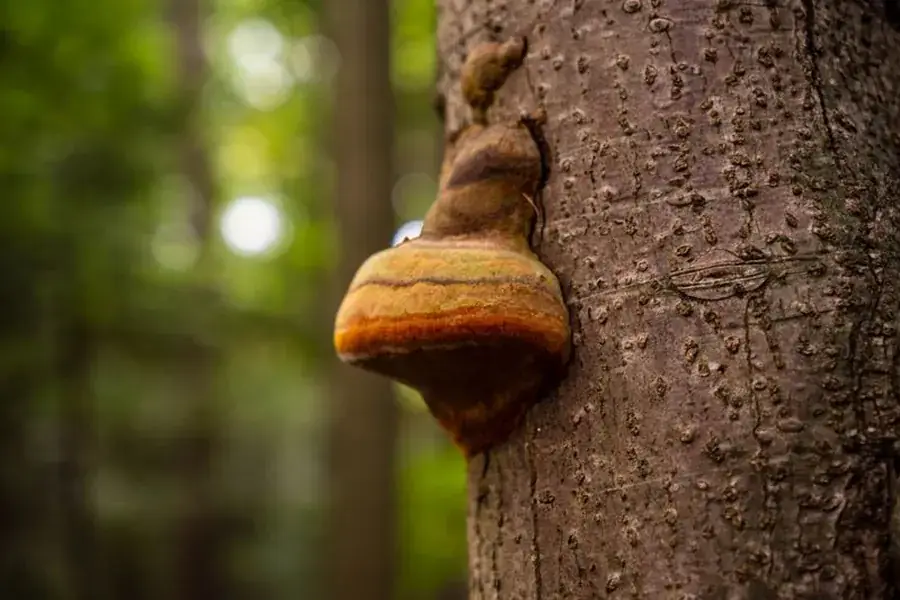
Athens-Clarke County uses a similar list when it decides whether a protected tree may be removed. The county's published criteria include a tree that is dead or in an unhealthy condition, more than 50% dieback of the crown, wounds larger than a third of the trunk's circumference, wounds deeper than two thirds of the trunk's diameter, limb defects that would need more than half the canopy removed to correct, an irresolvable conflict with infrastructure that creates a hazard, and pest or disease problems that cannot easily be cured and are likely to spread (Athens-Clarke County).
That list is useful even if your tree is not protected, because it is a reasonable standard for deciding whether removal is genuinely warranted or whether pruning would do.
Dead and hazardous tree removal
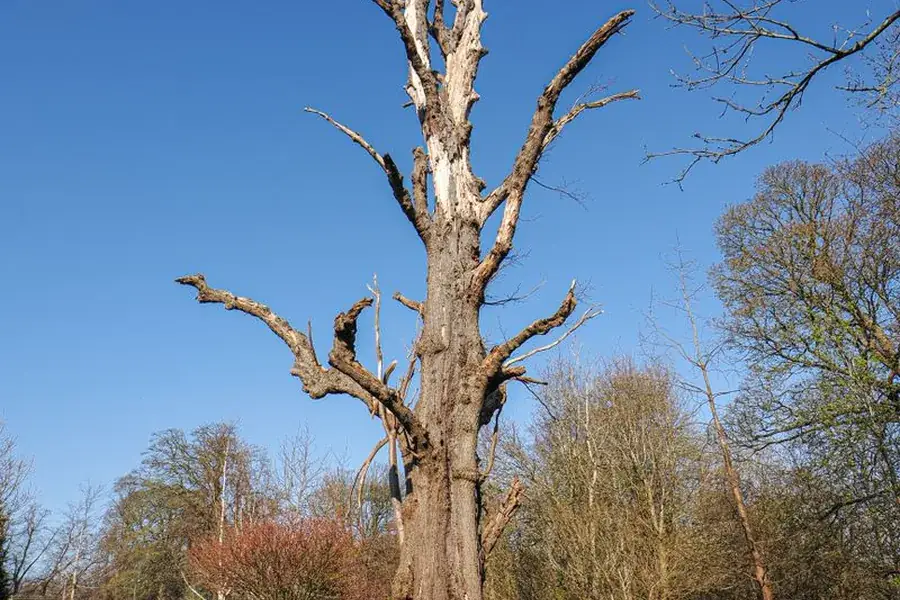
Dead, dying and hazardous tree removal is a large part of what we are called for, and it is planned and priced differently from taking down a healthy tree.
A dead tree does not become safe by standing still. It becomes more brittle, less predictable to climb, and harder to rig, which is why a dead pine costs more to take down than a live one of the same size.
It also carries a liability edge that a live tree does not. Athens-Clarke County's own guidance on Georgia tree law notes that dead tissue must be readily apparent or documented, and that while one small dead limb is not negligence, a tree full of dead limbs is a different matter (Athens-Clarke County). If you can see it from the street, so can everyone else.
If you are looking at a dead tree and wondering whether it can wait, the honest answer is usually that it can wait until we can get there, and not much longer than that.
Send a photo and we will tell you what we are looking at.
Request a free written estimateHow we take a tree down
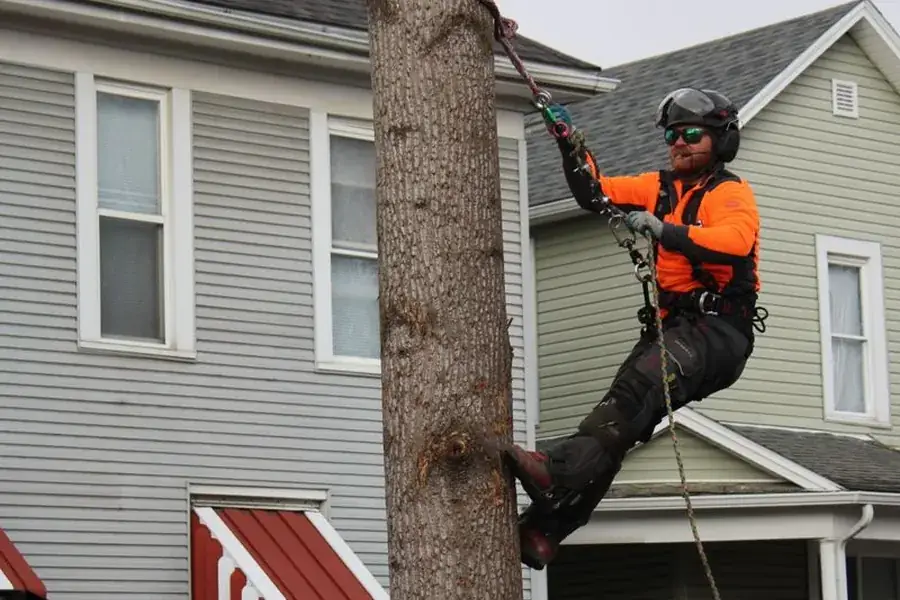
Call it tree cutting, tree felling or tree removal; on a residential lot it is nearly always the same careful job. Very few Athens removals are a matter of cutting at the base and stepping back. Most are close to a house, a fence, a driveway, a shed, or a neighbor's yard, so the tree comes down in pieces.
Access first. Before anything else we work out how equipment gets in and where the wood comes out. A back yard behind a narrow side gate is a different job from a front yard we can back a truck into, even for the same tree.
Rigging and sectioning. A climber or a lift takes the tree apart from the top down, lowering sections on ropes so nothing free-falls onto what is underneath. Where a piece is too heavy or the landing zone is too tight, a crane does the lifting instead.
Protecting what stays. Plywood and mats over turf and drives, and a plan for the beds and the irrigation you cannot see from the truck.
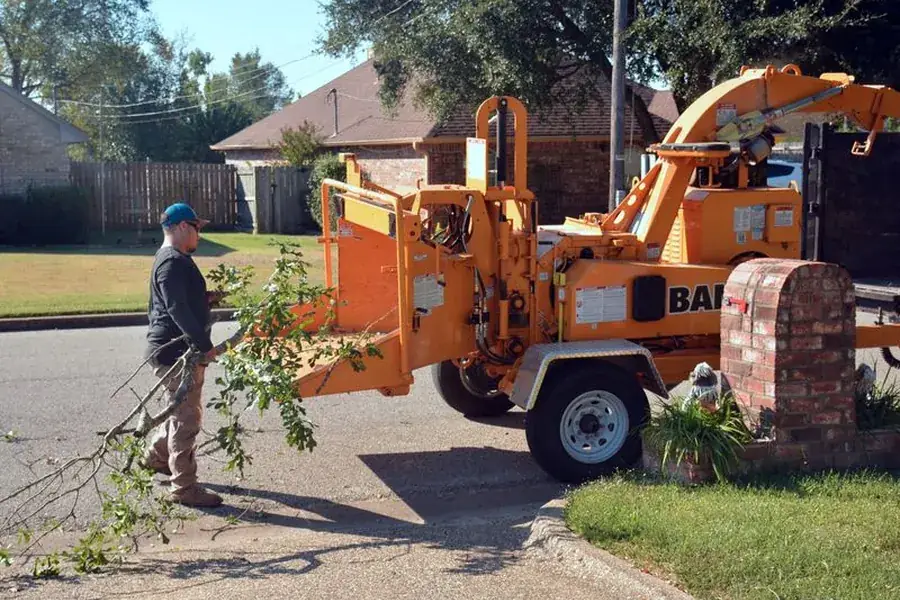
Cleanup. Brush chipped, wood cut down and handled the way you asked, ground raked. Cleanup is not a courtesy at the end of the job, it is a real share of the hours, which is why it shows up in the price.
What happens to the wood
You have options, and they change the price.
- We take everything. Simplest, and the most expensive, because hauling costs time and tipping fees.
- We chip the brush and leave the rounds. Popular with people who burn firewood. The rounds will need splitting.
- We leave the chips. Wood chips make usable mulch for beds and paths. Free, if you want them.
Tell us which you want before we quote, because it genuinely moves the number.
Taking several trees off a lot
Some jobs are not one tree. A row of pines along a fence line, a stand of dead hardwoods at the back of a property, or the trees that have to go before a garage or an addition can be built.
Several trees in one visit is cheaper per tree than several visits, because a large share of the cost is getting a crew and the equipment on site at all. We take the trees down, clear the brush and the wood, and grind the stumps if you want the ground usable.
What we do not do is grading, grubbing out root systems with an excavator, or preparing a site for construction. That is land clearing, a different trade with different machines and its own permits, and if that is the job you actually have, say so, because a tree crew is the wrong quote for it.
Two rules matter more here than on a single tree. In Athens-Clarke County the notification exemption covers five or fewer healthy trees in a year on a lot under one acre in single-family zoning, and a non-exempt property that clears trees can face a five-year timeout on development (Athens-Clarke County). Across the line in Oconee County, larger clearing runs into timber-harvest permitting through the Georgia Forestry Commission (Oconee County). We check which applies before we quote. The detail is on the Athens tree rules page, and the Oconee side is covered on our Watkinsville and Oconee County page.
Do you need permission first?
Sometimes. Outside the Milledge Avenue Overlay District, Athens-Clarke County's tree ordinance does not regulate trees on private lots that have not been developed since 2005, and non-protected private trees may be removed at any time for any reason (Athens-Clarke County). Protected trees, Landmark trees, larger lots, and anything that counts as timber harvesting are treated differently.
We check this before quoting rather than after. The Athens tree rules page sets out the criteria, including the five-or-fewer rule for smaller residential lots and what happens when the tree is on a property line.
What it costs
Size, access, what is underneath the tree, and how much of the day goes into cleanup. Nationally, tree removal averages around $850, with most jobs falling between $450 and $1,450, and large or hazardous removals running $2,400 to $3,400. Those are national figures, not Athens quotes, and they are here to set expectations rather than to price your tree.
Our page on tree removal cost in Athens explains what moves the number in each direction. Your actual price comes from a written estimate after we have looked at the tree.
Common questions
Will you grind the stump too?
Yes, and it is quoted separately, so ask for it up front if you want the stump gone. Details on the stump grinding page.
Can you get to a tree in a fenced back yard?
Usually. Access changes the method and sometimes the price, not whether the job is possible. Standard gates are narrow, so tell us about the gate when you call.
Do you remove trees for landlords and commercial property?
Yes. The process is the same, and the estimate goes to whoever is paying.
How much notice do you need?
For routine removals, days rather than weeks in most cases. For anything actively dangerous, call (571) 412-0006 and we will treat it as an emergency.
What is the best month to cut down a tree?
For a healthy tree that can wait, the dormant winter season is the easiest time: no leaves to handle, firmer ground for the equipment, and the structure of the tree visible from the ground. That is the same window University of Georgia Extension points to for most pruning (UGA Extension). A dead or hazardous tree does not get to wait for a season, and neither does a tree that is already leaning at something.
My neighbor's tree is the problem. What can I do?
That is a real and common situation, and Georgia has specific rules about boundary trees and about who is liable when one fails. We have set out what the county publishes on the tree rules page.
Get it looked at
Send a photo, tell us what you are seeing, and we will come out and put a price in writing. Removal is the biggest job our Athens tree service does, and it is the one we are most willing to talk you out of.
Request a free written estimate or call (571) 412-0006.